


About
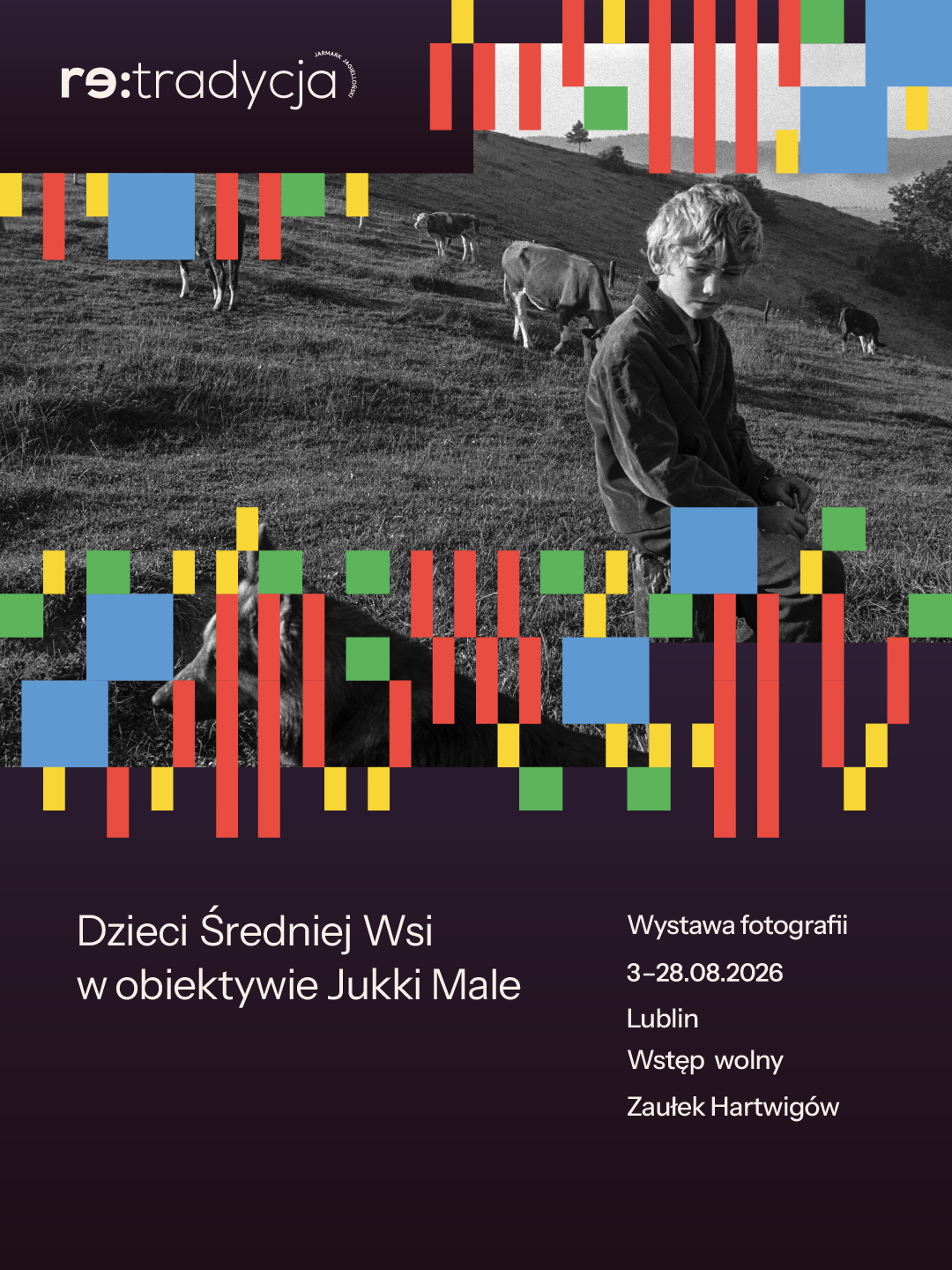
Thirty-six years of returning, an extraordinary bond with the local community, and a priceless archive of rural life. Throughout August, as part of the Re:tradition – Jagiellonian Fair festival, visitors will be able to see an exhibition of photographs by Finnish artist Jukka Male. The “Children of Średnia Wieś” project is a moving and authentic record of the social and cultural transformations of the Polish countryside – from the era of the Polish People’s Republic to the present day. The remarkable photographs will be on display at the Hartwig Alley.
Jukka Male is a Finnish photographic artist who first came to the village of Średnia Wieś, located in the Bieszczady Mountains in southern Poland, in 1979.
Średnia Wieś looks like an ordinary Polish village. Even its name could be misinterpreted as meaning an average or ordinary village. In fact, the village’s modern name comes from Terpiczów, a settlement that was once divided into three parts, specifically its middle section – Terpiczów Średni. The people here live just as they do anywhere else
– explains the photographer.
For 36 years, he kept returning to the same places and people, documenting their lives and the changes they experienced. The villagers welcomed him warmly, and over time he earned their trust and friendship. Jukka Male photographed everyday life, family celebrations, work, and leisure. Thanks to his long-term documentation, we can witness these transformations – children seen in his black-and-white photographs later reappear as teenagers in colour images taken in the “new Poland.”
The selection of works presented in the exhibition focuses primarily on children, whose lives Jukka Male portrayed as they truly were – without unnecessary staging or idealisation. We see them playing, working, and resting. They are full of the simple joy of being together and having fun, while also helping with farm work and supporting their parents and grandparents. We also see the world in which they grew up – the yard, the fields, the family home, and the people closest to them.
The black-and-white photographs were taken between 1979 and 1981, while the colour images date from the post-communist period. The use of colour is an essential part of the artist’s visual language, but it also serves as a marker of time and social change.
For a very long time, I observed Średnia Wieś in the dark, without knowing the region’s difficult history. I first came here because I wanted to see the hilly landscape furthest away from Finland. I was looking for an inspiring environment, so I kept travelling through increasingly hilly regions until I reached the Northern Carpathians. It happened by chance, and fortunately so.
My photographs of Średnia Wieś span 36 years. My first visit was in 1979, and the last one took place in April 2015. During that time, both Poland and Średnia Wieś underwent enormous changes – the collapse of the socialist regime and, later, Poland’s accession to the European Union.
Since my first visit, the most visible change in the village has been that three hundred cows and one hundred horses have vanished from the landscape. But an even greater change has taken place in my own mind. Because of what is invisible.
The exhibition is presented as part of the “Summer School of Tradition” project.
The Summer School of Tradition is organized by the Kultura Enter Foundation.
The project is implemented with the support of the City of Lublin.
In cooperation with: Workshops of Culture in Lublin, the Re:tradition – Jagiellonian Fair festival, and the Dominican Monastery in Lublin.
Details
When: August 3-28, 2026, open 24 hours a day
Where: Hartwig Alley
Admission free
About the Re:tradition – Jagiellonian Fair festival
Re:tradition is an extraordinary festival of traditional music and craftsmanship. During three August days and nights, Lublin transforms into the capital of living traditional culture.
The festival program offers a wide range of attractions for both children and adults. It provides a unique opportunity to meet master artisans who, each year, showcase their exceptional handmade creations. Traditional music is also a key element of the Re:tradition festival, presented both in its authentic form and through the interpretations of contemporary artists.
The festival also features evening dance parties with live music, workshops, exhibitions, performances, film screenings, and meetings. Younger visitors can enjoy the Re:tradition Playground, where traditional games and pastimes are brought back to life.
The festival allows visitors to hear, see, touch, and experience folk culture, which during this time completely fills the streets of Lublin’s Old Town.
Details
Re:tradition – the Jagiellonian Fair
August 21-23, 2026
Lublin, Old Town
Admission to the event is free.
Organisers: Workshops of Culture in Lublin, Cultural Institution of the City of Lublin, Lublin City of Inspiration
Honorary Patronage: Krzysztof Żuk, Mayor of the City of Lublin; the National Heritage Institute
Patron: Ministry of Culture and National Heritage
Media Partners: TVP Kultura, TVP3 Lublin, TVP ABC, Program II of Polskie Radio, Polskie Radio Dzieciom, Radiowe Centrum Kultury Ludowej, Radio Lublin, Gazeta Wyborcza, Weranda Country, KulturaLudowa.pl, MuzykaTradycyjna.pl, Kultura Enter, ONET
Partners: Lublin Airport, Kultura Enter Foundation, Gardzienice Centre for Theatre Practices, Old Theatre in Lublin, Dominicans of Lublin, the National Museum in Lublin, Ivan Honchar Museum, the Association of Folk Artists
Co-financed by the Ministry of Culture and National Heritage of the Republic of Poland from the Culture Promotion Fund.