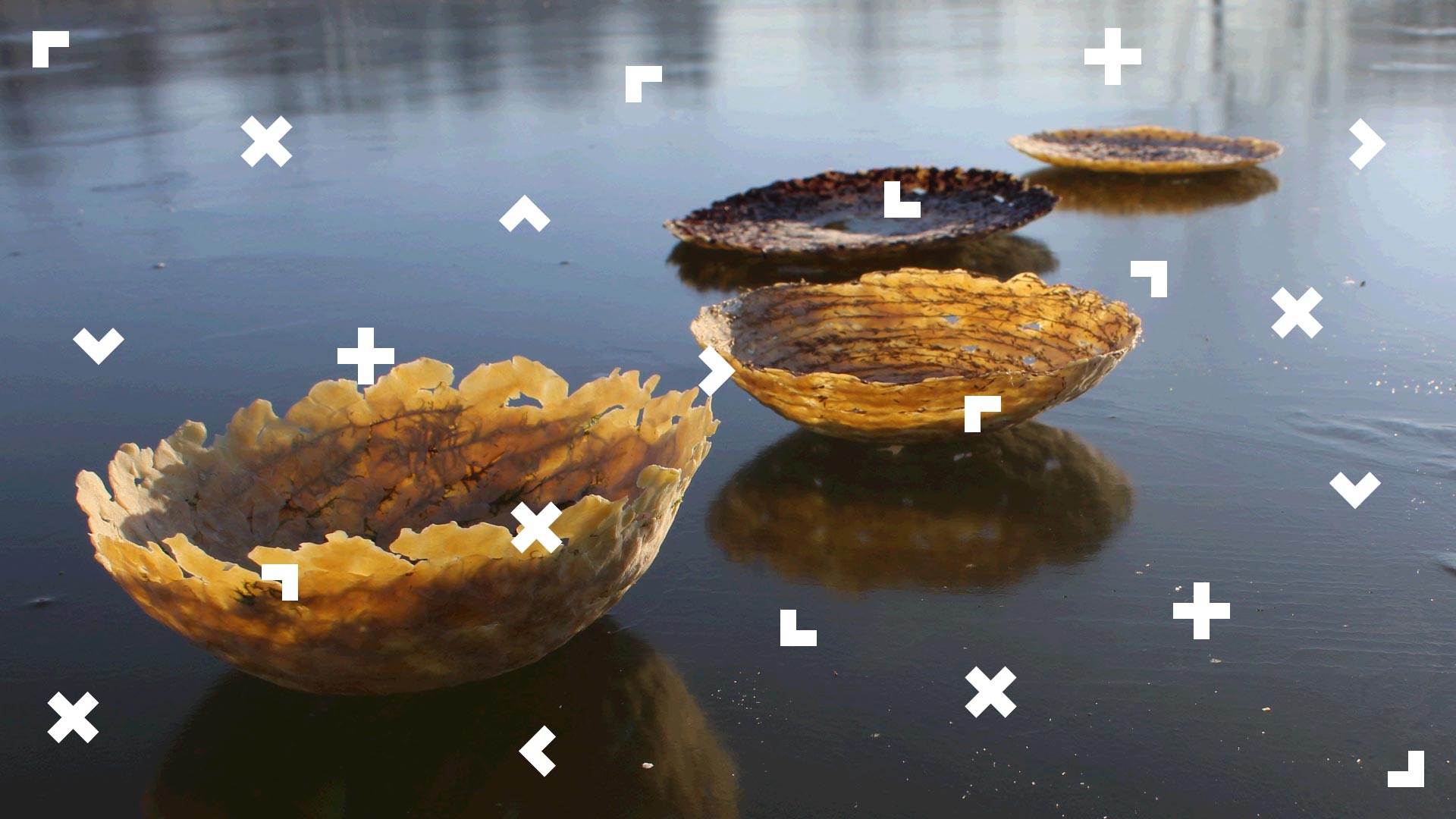
Na wodzie unoszą się cztery półokrągłe łódki przypominające głębokie talerze. Są wykonane z naturalnych elementów, prawdopodobnie jest to odlew z gliny.
Logotypy

In 2023, the “Land Art on the Border” project culminated in a presentation of 11 unique works, the result of an artistic residency in Sławatycze, on the banks of the Bug River. Each story was woven from willow, moor grass (Molinia caerulea), and beeswax. These “conscious interventions” prioritized nature, celebrating the creative process under the guidance of Master Artist Mirosław Maszlanko.

Since these works are entirely biodegradable, they were designed to yield to the environment shortly after creation.

Funding & Credits:

Funded by: Ministry of Culture and National Heritage (National Centre for Culture – Kultura – Interwencje 2023).

Photography: Marcin Butryn and Fotoklub Podlaski.
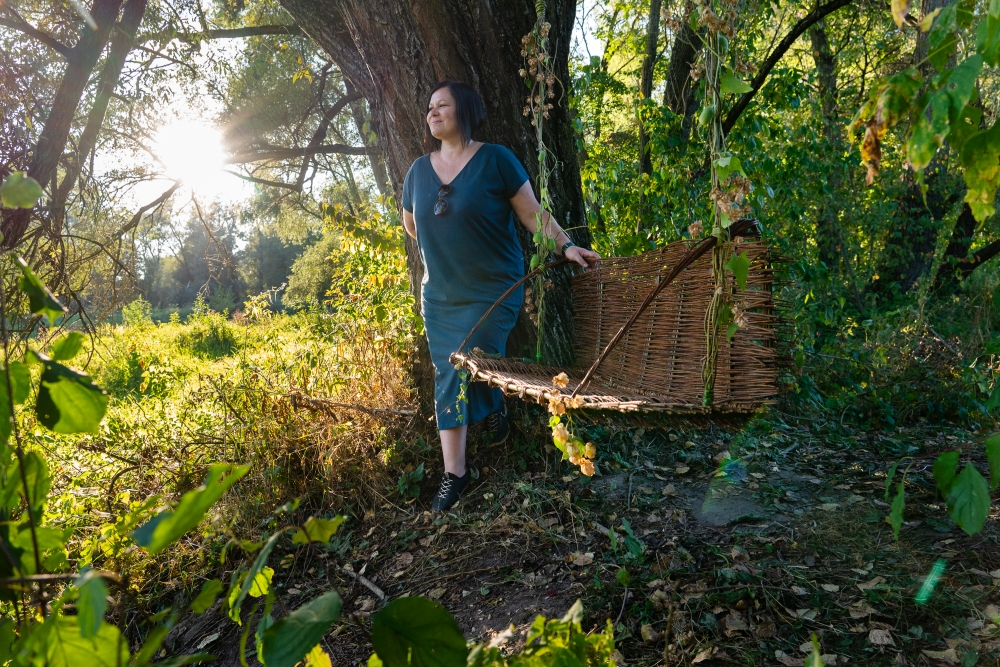
Kobieta stoi oparta o drzewo. Po jej prawej stronie znajduje się huśtawka upleciona z wikliny.

Anna Szczygieł | A Good Place

“Sławatycze enchanted me, but I quickly realised the Bug River is now a place of tension—guarded by soldiers and wire. I wanted to reclaim that beauty. I wove a swing from willow and hung it over the water. In my mind’s eye, I see children playing here again, reminding us that despite the conflict, this remains a Good Place.”

Na drzewie jest zawieszona tuba z wikliny. Przed nią stoi młoda dziewczyna.

Antonina Dutkiewicz | Listen

“My work was born from a need to respond to the sounds around me. This rounded form is both a tube for catching animal calls and a lens for observing the stars. Once you isolate yourself within it, your senses sharpen; you begin to truly hear the whispers of the landscape.”

Dziewczyna stoi otoczona drzewami, na których są zawieszone kwiaty zrobione przez warsztatowiczkę.

Adrianna Iwanejko | Little Stars

“I created this installation from grass gathered in local meadows, inspired by the folk decorations that once hung in village homes. In this wild orchard, these ‘levitating’ stars remind us that the sky and the wonders of childhood are shared, no matter which side of the river you are on.”

Dziewczyna stoi koło swojej pracy. To pajęczyna z wikliny zwisająca z drzewa.

Jakub Ziółkowski | Constellations

“I wanted to catch the beauty of the stars in willow. My work is about unity with nature—an arrangement that is barely there, inviting you to stop for a fleeting moment among the stars as they sway in the river breeze.”

Dziewczyna siedzi w wiklinowym koszyku, który sama uplotła.

Karolina Zielińska | Joy

“A cradle, a swing, a symbol of freedom. I hung it over the Bug to highlight the contrast between the idyllic nature and the ‘darkness’ of the border restrictions. I hope this monument to childhood joy can, if only for a moment, clear the hearts of those who visit this anxious terrain.”

Kobieta stoi pod pajęczyną zawieszoną na drzewie.

Lena Jungowska | Sphere

“I began with the idea of a nucleus—the micro and the macro. As I worked, the material began to speak to me, turning into something organic and living. For me, the process was a dialogue with the infinite, an experiment in how life emerges from simple parts.”

Kobieta stoi w lesie i prezentuje swoją pracę. To ażurowe koło.

Martyna Groth | The Infanta

“She was born at the very end of the process, a meeting of grass and beeswax. Her shape recalls the heavy, oppressive dresses of the past—the ‘Infantas’ of Velázquez or Kantor. But my Infanta has escaped; she lives free and wild in the secret forest by the river.

Dziewczyna patrzy na swoje dzieło. To pajęczyna rozciągnięta między drzewami.

Maryla Świderska | “The Net”

This was my first time working with willow, and I followed my intuition. The process of weaving felt exactly like a spider spinning its web. I placed this white ‘Net’ in the shadows of the trees to create a sharp contrast—a graphic intervention in the green silence.”

Dziewczyna przygląda się pajęczynie z wikliny, którą sama zrobiła.

Martyna Biszczad | Demiurge

“I have a fear of spiders, yet their webs fascinate me. This piece interprets the web as a ‘Pająk’—the traditional folk chandelier meant to protect a home from evil. It is a demiurgic form, a cosmic system that brings order and harmony to the chaos of the world.”

Kobieta siedzi w wiklinowej łódce. Dookoła są zarośla.

Karolina Ben | The Nest

“This is a story about building a home—about the need for ‘nesting’ to feel safe. I placed a stump inside this willow nest as an invitation. Anyone who needs a moment of rest can sit here and simply watch the slow, quiet current of the river.”

Kobieta z psem siedzą przy instalacji artystycznej z wikliny w kształcie krzyża.

Marzena Bielecka – “Mokosh”

” I created the symbol of the Slavic goddess Mokosz—Mother Earth—inside an old hearth. It is a gesture of rebirth for a forgotten place. It’s a call to return to our roots and to the harmony with nature that we so desperately miss in today’s world.”

Mężczyzna stoi przy wyplecionej przez siebie pajęczynie z wikliny.

Photo credit: Fotoklub Podlaski

Mirosław Maszlanko | Time Capsule

“I suspended this seed-shaped vessel among young spruces—a dark backdrop for a fragile form. I filled this ‘grain’ with solastalgia, the grief for a wild world we are losing. I dedicate this to the activists fighting for the Carpathian Forest; it is a seed of thought about the power and fragility of life.”