About the event
Field recordings listening sessions return to Different Sounds (July 2–5, 2026, Lublin)! After last year’s very warm reception of our new program proposal from the Different Sounds audience, we are coming back with another edition of the Sound Reset. This time we invite you to a meditative and collective immersion in the sounds of slowly disappearing worlds, as well as to attentive listening that allows you to catch your breath amid the festival bustle.
This is the 19th edition of Different Sounds in Lublin, organized by the Workshops of Culture, and the 13th edition within the East of Culture, a project carried out by the National Centre for Culture using funds from the Ministry of Culture and National Heritage and by three cities in eastern Poland – Lublin, Białystok, and Rzeszów.
What will we hear?
During three festival mornings (Friday–Sunday), we will create a sound space designed for auditory rest. In a darkened interior free from visual distractions, on comfortable cushions and loungers, you will be able to listen to sets of field recordings prepared for Inne Brzmienia by Ludwig Berger, Iza Smelczyńska, and Maciej Wirmański.
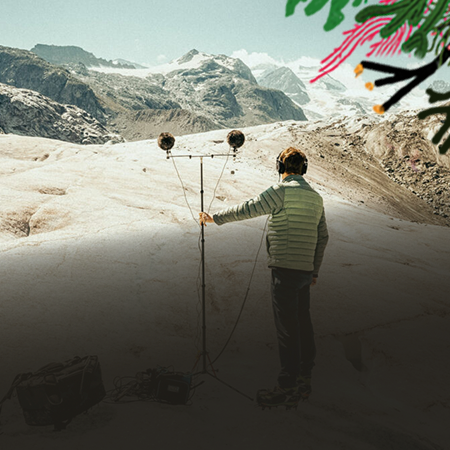
Each of the three listening sessions presents a different soundscape and a form of auditory documentation of worlds that are disappearing from our sight and hearing. “The First Last Day” by Iza Smelczyńska is a deeply personal sound postcard from the last day of the school year in Warsaw’s Mariensztat district. “Sounds of Extinction” by Maciej Wirmański documents the soundscapes of the Orawsko-Nowotarskie Peatlands, areas affected by human pressure. Meanwhile, Ludwig Berger’s recordings take us to the retreating Morteratsch Glacier in the Swiss Alps. This session will be accompanied by a screening of the documentary film “Crying Glacier”, nominated for the News & Documentary Emmy Awards.
Rest, reset your ears, and tune them for further musical experiences of Inne Brzmienia.
The Sound Resets are also accessible for blind and visually impaired audiences. If you would like to attend and require assistance, please let us know by email no later than 3 days before the festival – send a message to: wolontariat@warsztatykultury.pl.
Programme
July 3 (Friday), 11.00-12.00 | “Sounds of Extinction – The Orawa-Nowy Targ Peatlands” | Maciej Wirmański
July 4 (Saturday), 11.00-12.00 | “Crying Glacier” | Ludwig Berger (listening session + screening of the short documentary film)
July 5 (Sunday), 11.00-12.00 | “The First Last Day” | Iza Smelczyńska
Where: Workshops of Culture in Lublin, Grodzka 5a – auditorium
Admission free
Attention! The listening room closes shortly after 11:00, so please be punctual!
How to prepare for the listening session
Arrive at least a few minutes before 11:00 and choose your listening space; cushions, deck chairs and blankets will be available.
Turn off your phone and do not use it during the session – the room will be darkened and the screen light may disturb others.
If possible, avoid leaving during the listening session – it may distract other participants.
A mind accustomed to listening to music may initially struggle to follow subtle individual sounds – give yourself time: close your eyes, relax, and follow the diversity and changes in the soundscape.
Each listening session consists of several dozen minutes of sound without visual stimuli – consciously give them up and begin to listen more deeply, more widely, more attentively.
About the recordings and their authors
“Sounds of Extinction – The Orawa-Nowy Targ Peatlands” | Maciej Wirmański
When: July 3 (Friday), 11:00-12:00
Where: Workshops of Culture in Lublin, Grodzka 5a – auditorium
Admission free
The Orawa-Nowy Targ Peatlands are a Natura 2000 area stretching across southern Małopolska, in the Orawa-Nowy Targ Depression, from Chochołów to Nowy Targ. Southern Małopolska is an area mainly associated with mountain habitats and landscapes; however, between the Gorce Mountains, Babia Góra and the Tatra Mountains lies a little-known flatland dominated by peat bogs, wetlands and swamp forests.
Read more
Calls for the protection of these habitats appeared as early as the beginning of the 20th century, and a small fragment of the Orawa-Nowy Targ Peatlands – Bór na Czerwonem in Nowy Targ – was designated a nature reserve as early as 1925. At that time, the remaining Orawa-Nowy Targ Peatlands were subject to human pressure: peat extraction, drainage, cutting of swamp forests, and conversion of wetlands into fields and meadows.
Despite centuries of pressure from forestry, agriculture and mining, the Orawa-Nowy Targ Peatlands remain a rich complex of unique habitats that are home to many organisms. Although there is currently no need for exploitation of this area, it is being systematically destroyed by global climate change, pressure from hunters, foresters, developers and local authorities. The peatlands are damaged by continuous drainage works, the destruction of beaver dams, and illegal off-road vehicle, quad and motorcycle traffic. Drained peatlands are also frequently affected by destructive fires.
“Dźwięki wymierania – Torfowiska Orawsko-Nowotarskie” consists mainly of sounds from a natural environment that has been severely damaged by humans and, despite scientists’ calls for the creation of a national park or landscape park with a network of nature reserves, continues to be destroyed. The recorded sounds are far from dramatic events: they are birdsong, the sound of streams and wind moving through trees, and distant sounds of villages. The song of a skylark appears over a dying peatland where, just 30 years ago, dozens of black grouse gathered for their leks. Duck recordings were made at a fire reservoir located in a former peat excavation pit near the last active and legal peat mine. The sound of a clear stream is in fact water flowing through a drainage ditch that is leading to the peatland’s destruction. A barking fox was recorded near a den that is still being destroyed by hunters. The distant sound of a tractor is not a sign of harvest, but an offence: an unknown perpetrator, as later noted in a police report, is transporting illegally extracted peat on a cart.
The recordings were made between 2019 and 2026 in the Orawa-Nowy Targ Peatlands in the municipalities of Jabłonka, Czarny Dunajec and Nowy Targ.
Maciej Wirmański – sound engineer, field recordist, musician, publisher, curator of music scenes, cultural activist, music critic. He works with field recordings and soundscapes composed of found sounds for art and museum exhibitions. He creates sound installations, theatre music and film music. Since 2017 he has run the Szara Reneta Tapes label, which releases experimental music, noise, field recordings and radio plays. As part of the Magury ’97 project, he creates fake folk noise music inspired by the Carpathian Arc. He works as a sound engineer for film, TV, documentaries and other audio productions, focusing on post-production of sound and music. He lives and works in Podhale. Amateur birdwatcher.
https://maciejwirmanski.pl/
https://maciejwirmanski.bandcamp.com/
https://szarareneta.bandcamp.com/
“Crying Glacier” | Ludwig Berger
When: July 4 (Saturday), 11:00-12:00
Where: Workshops of Culture in Lublin, Grodzka 5a – auditorium
Admission free
“Crying Glacier” is a project by sound artist Ludwig Berger, comprising a field recordings album, a sound installation, and a short documentary film. Together, they document Berger’s long-term practice of listening to and recording the sounds of the Morteratsch Glacier in the Swiss Alps. For over a decade, Berger has regularly returned to the site, and these visits have gradually begun to resemble encounters not so much with a place, but with a living, changing entity. “Crying Glacier” reveals a unique relationship between the artist and the glacier, inviting us to listen to a landscape that is irreversibly changing before our eyes and ears.
Read more
During Different Sounds, we will listen to field recordings from the album “Crying Glacier”, selected by Bandcamp and A Closer Listen as one of the most important field recording releases of 2025. Each track reveals a subtle yet highly complex sonic landscape of the Morteratsch Glacier. In water-filled crevices, peculiar voices emerge – some resemble birdsong, others human speech, and still others evoke the sound of synthesizers. Overlapping, they form a dense, multilayered texture of glacial noise. Melting ice reveals a rich repertoire of acoustic phenomena: murmurs, growls, bubbling, cracking, fractures, and rushing water. The Morteratsch Glacier speaks its own language, and the diversity and expressiveness of its sounds are truly captivating.
Immediately after the listening session, there will be a screening of the short documentary film “Crying Glacier” (14’13”, dir. Lutz Stautner), nominated for the News & Documentary Emmy Awards in the category “Outstanding Climate, Environment or Weather Coverage”. The film explores the process of recording the glacier’s sounds and the ideas behind the project. In its final scene, it delivers a striking warning: “Without effective climate protection, there is a high probability that Ludwig Berger’s recordings will outlive the Alpine glaciers.” “Crying Glacier” is therefore not only a unique listening experience, but also a powerful testimony to environmental change.
“This is more than a scientific record – it is an almost intimate sensory experience that confronts the listener with the tangible reality of global warming” (Radio Télévision Suisse).
Ludwig Berger – sound artist, composer, educator. In his artistic practice he combines acoustic ecology, deep listening, and poetic narration, creating sound installations, compositions, sound walks, and radio documentaries. His work moves between interspecies, geological, and architectural listening, with a particular interest in microscopic acoustic phenomena such as insect communication, plant rhythms, and the sounds of melting glaciers. He studied electroacoustic composition, musicology, art history, and German literature. As a researcher and lecturer at the Institute of Landscape Architecture at ETH Zurich, he focused on the sonic dimension of Alpine glaciers and water infrastructure. His work has been recognized with awards including the Prix Ars Electronica and the Sound of the Year Awards. His projects have been presented at the United Nations headquarters in New York, the Venice Architecture Biennale, the Canadian Centre for Architecture in Montreal, ZKM Karlsruhe, and at GRM Acousmonium in Paris.
https://ludwigberger.com/
https://ludwigberger.bandcamp.com/
https://www.crying-glacier.com/
“The First Last Day” | Iza Smelczyńska
When: July 5 (Sunday), 11:00-12:00
Where: Workshops of Culture in Lublin, Grodzka 5a – auditorium
Admission free
The work is an unprocessed sound recording captured on the last day of the school year at Mariensztat in Warsaw. The recording was made in a hidden garden behind a kindergarten – an enclave of greenery with old trees, known almost exclusively to local residents. This was the shortcut route taken by the author and her daughter. On this day, however, Wanda completes her kindergarten education for good.
Read more
The recorded acoustic landscape intertwines the promise of the first days of summer with the melancholy of the final moments in kindergarten. The space is completely free from the noise of the capital and the nearby W-Z Route. The architecture and dense greenery of Mariensztat act as a natural filter and acoustic buffer. Sounds from the kindergarten playground – children’s laughter, carefree chatter, and the calls of caregivers – reach the microphone from a distance, blending with birdsong.
This acoustic distance becomes a direct metaphor for the inevitable farewell to early childhood. Sounds filtered through space and lush vegetation seem as if they already belong to the past, gradually receding into memory.
The sound postcard, though deeply personal and imbued with subtle nostalgia, avoids sentimentality. The work is based on attentive listening to what unfolds naturally – without digital manipulation or effects. It is a tender documentary record of a fleeting moment of transition and a threshold beyond which the sounds of a safe micro-world become only a memory.
Iza Smelczyńska – musicologist, composer, and writer. She works within experimental electronic music and field recording. She is interested in acoustic ecology and different modes of listening, which resonates in her works defined as “sound essays.” She composes music for radio plays and theatre performances. Her works have been presented at festivals including MUTEK (Montreal), CTM (Berlin), “Warszawska Jesień,” and Sanatorium of Sound. She writes about music for “Glissando” and “Ruch Muzyczny,” and co-hosts “FLIS: a podcast about music and listening” on culture.pl.
About the East of Culture – Different Sounds
The East of Culture – Different Sounds festival is a tribute to musicians who choose authenticity over popularity built on artistic compromise. At a time when culture is increasingly becoming a luxury commodity, Different Sounds serves as a reminder that quality should never be a privilege. It is an event for those who believe that music can be a space for encounter, reflection, and a sense of community—not merely consumption. For seekers who understand that the greatest revelations emerge where there are no ready-made answers. In a world where everything seems to have a price, Different Sounds offers something beyond value: a moment when sound becomes a language of communication and the audience becomes a co-creator of the experience.
This year’s line-up features Backengrillen, Therapy?, Sun Ra Arkestra, Dead Bob, Kap Bambino, Dälek, Tramhaus, Leila Bordreuil & Drew McDowall, Mats Gustafsson & Kimmo Pohjonen, Drank, Furia Plays Cinema, Marcin Masecki & Boleros, YANA, Hinode Tapes, Only Mess & Guests, Grupa Torpedo, AcidSitter, Nina Eba, Heinali & Andriana—Yaroslava Saienko, and The B17. The organisers will also host the renowned Vienna-based record label Trost Records.
The East of Culture – Different Sounds festival is not only about music. It is also a meeting place for some of the most compelling voices in contemporary Central and Eastern European literature. These encounters will take place within the Eastern Express series, featuring conversations with authors, translators, and literary professionals, as well as presentations of the latest releases published by Workshops of Culture Publishing House.
The programme will also include exhibitions, talks, music workshops for children, and the return of last year’s audience favourite–the Sound Resets.
As always, admission to all festival events is free of charge, with more announcements coming soon.
More information about the festival can be found at innebrzmienia.eu and nck.pl/projekty-kulturalne/projekty/wschod-kultury.
East of Culture – Different Sounds
July 2-5, 2026, Lublin
Admission free
Organisers: Ministry of Culture and National Heritage of Poland, The National Centre for Culture Poland, The City of Lublin, the Workshops of Culture in Lublin.


