


Monika Popiel and Paweł Świerczek – Stimpathy | exhibition opening
About the event
Do you sometimes fiddle with a pen while talking, tap your foot when thinking about something, or hum under your breath to calm yourself down? Such small gestures and sounds help us to cope with emotions and stimuli. For many neurodivergent people, they are a particularly important way of experiencing the world and ensuring their own comfort.
The exhibition ‘Stimpathy’ by Monika Popiel and Paweł Świerczek invites you to take a closer look at them. Using image, sound and an extraordinary art installation, it shows what we often fail to notice on a daily basis and sometimes try to get rid of because it doesn’t fit in with social norms. This is an opportunity to look at the human body and its needs from a different perspective, to discover unconventional ways of communicating and to consider whether we all really need to behave in the same way.
Curatorial text
In their artistic and research practice, Monika Popiel and Paweł Świerczek deal with neurodivergent perception, the embodiment of neurodiversity and stimming as a relational practice. Through working with the body, sensory objects, theoretical texts and public actions, they examine what allows neurodivergent people not only to survive but also to thrive in a world that considers neurotypical, able-bodied and heterosexual people to be the norm. They show that what is personal is also political.
At the centre of their interest is stimming (self-stimulatory behaviours), i.e., repetitive movements and sounds that neurodivergent individuals use to regulate emotions and stimuli. Although there is increasing talk about neurodiversity, stimming is still rarely recognised as an important bodily, cultural or relational practice. It is more often overlooked, concealed, corrected or considered a pathology. Artists want to change this through neuroqueering, which – as Dr Nick Walker writes – means breaking both norms relating to the mind and those relating to gender. Both types of standards are closely linked and affect how we move around the city, how we work, relax or interact with other people. From this perspective, stimulation is a way of conveying meaning through sensory exploration. It is about caring for your own nervous system in a world that often denies this care, and making space for your own rhythm, even if it does not fit the demands of linear productivity. Stimulation can become a language; you just need to learn to listen to it.
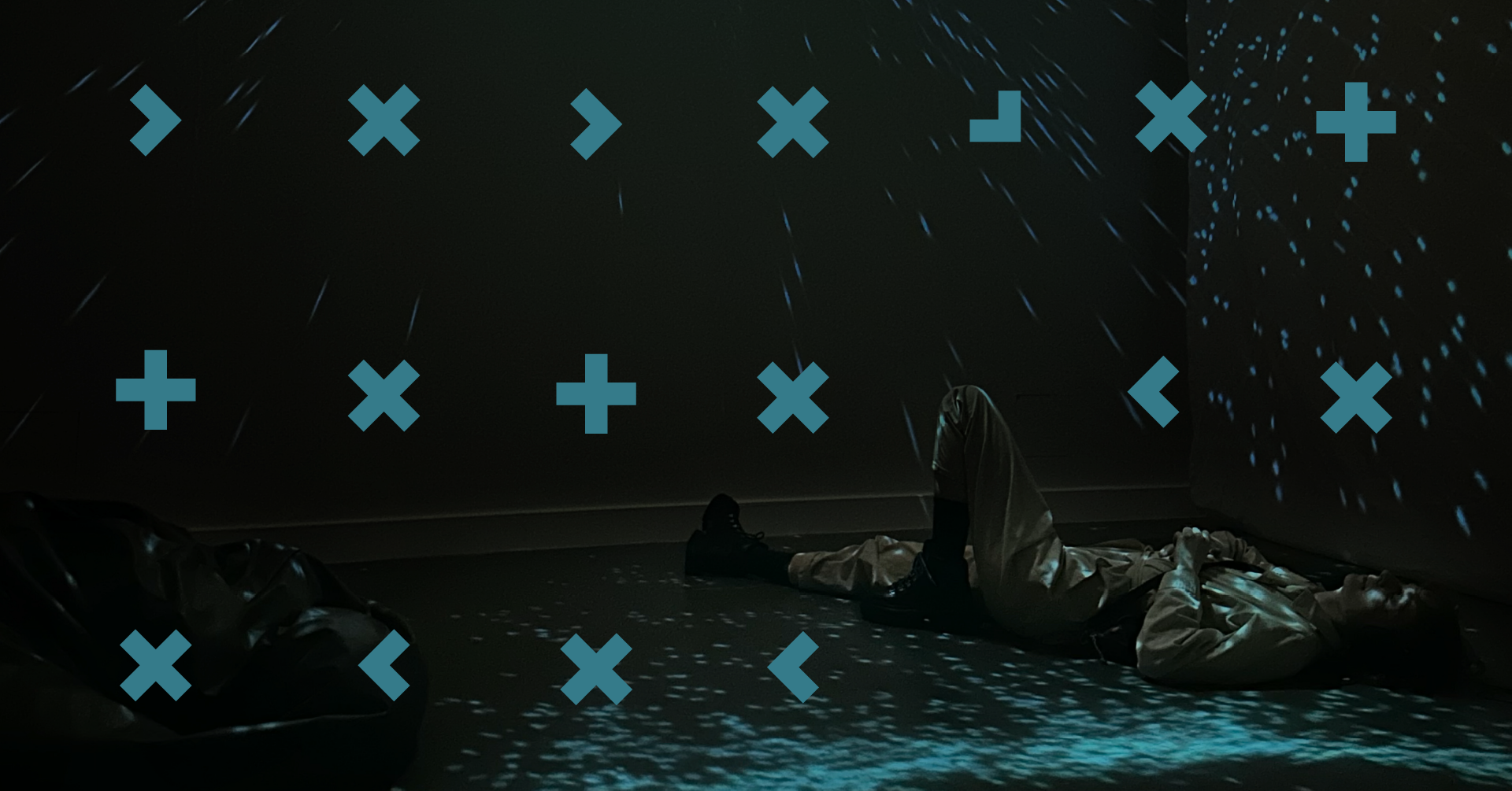
The ‘Stimpathy’ installation stems from encounters with neurodivergent residents of Berlin. Instead of recording their voices, the artists recorded their stims and bodies in contact with their favourite places in the city. In close-ups so tight that the image loses its scale and becomes a tactile experience, people, animals, plants, and inanimate matter are stimulated. The projection falls on an object resembling a halo, from which emerges a shape that references one of the most direct gestures of protest. It cannot be discussed, so the easiest thing to do is to consider it madness; in the installation, it is elevated to the status of holiness. It is also a nod to the medieval saints, who today would most likely be considered neurodivergent. The object is covered with mirrors from a disco ball, on which the image is split and scattered across the walls, ceiling, floor and the bodies of the visitors. From the sound stems collected during the workshops, a musical piece was composed by Valyen Songbird. The video and audio are looped, but their loops are of different lengths, so the arrangement of what is seen and heard is constantly changing. The project aims to make visible what usually remains hidden, to empower neurodivergent individuals and to familiarise people with the presence of stimming in public spaces.
The ‘Stimpathy’ project was carried out as part of the Fresh AIR residency organised by Stiftung Berliner Leben.
More about the project: stimpathy.com
About the authors
Monika Popiel (pronouns: any) works at the intersection of various disciplines, blending artistic, technological, and research practices. She graduated in directing from the Theatre Academy in Warsaw and in applied mathematics from the Gdańsk University of Technology. At the core of her work is the body as the primary site of experience, relationships, and knowledge. In her explorations, she combines performative, relational, sensory and somatic arts with embodied practices of textile making, electronics design and interface programming. She creates interactive meeting spaces in which the body and the senses not only become the material and tool for action but also actively co-create them. Her works explore the dynamic relationships between bodies, memory, imagination, technology and the multisensory experience of the world. By working intensively with the sense of touch, interoception and movement, she poses questions about empathy, co-existence in uncertainty and dissonance, and the possibilities of joint action.
Website: monikapopiel.com
Paweł Świerczek – graduated in Cultural Studies from the University of Silesia in Katowice and from the Laboratory of New Theatrical Practices at SWPS University in Warsaw. He works at the intersection of performative and relational practices, artistic research, and (neuro)queer activism. At the centre of his interests are the tensions between identity politics and embodied experience, particularly queer and neurodivergent experience. In recent years, he has primarily explored the queer heritage of Upper Silesia (‘Of Coal and Rainbow / Wungiel i donga’, Sophienasele, Berlin 2018; ‘From Ahead Our Time’, Favoriten Festival, Dortmund 2022; Śląsk Przegiety collective, 2018–) and the bodily experience of neurodivergence (‘Stimpathy’, Fresh AIR, Berlin 2026). Since 2023, he has been practising and teaching the embodied communication method known as Authentic Relating.
Website: pawelswierczek.com
Sound consultation and composition: Valyen Songbird
Sound stimuli: participants in the Stimpathy workshop
Visual stimuli: Adaś, Célestin, Jenny Döll, Jarosław Gudowski, Katarzyna Mach, Martyna Masztalerz, Monika Popiel, Valyen Songbird, Paweł Świerczek, Tesia, Tere Więcko, Daniel Z.
Special thanks: Raum für Beteiligung Tempelhof-Schöneberg, Karada House
Curator: Agata Sztorc-Gromaszek
The exhibition presented at the Workshops of Culture is part of the ‘Art of Sensitivity’ project, co-financed by the Minister of Culture and National Heritage from the Culture Promotion Fund.
Details
When:
19 October 2026, 18:00 | exhibition opening
26 October – 13 November 2026 | visits | Monday to Friday from 10:00-17:00 and during selected events accompanying the exhibition
Where: Workshops of Culture in Lublin, Grodzka 7, exhibition hall, 2nd floor
For: young people aged 15 and over and adults
Free admission
Accessibility
The exhibition takes place in a darkened space. The video projection is displayed on an object resembling a disco ball. The space is filled with the diffused light of a disco ball and a variety of sounds made by people and a steel drum. Some visual or auditory stimuli can cause discomfort in sensitive individuals. Noise-cancelling headphones are available in the exhibition space.
- The event takes place on the second floor. There is no lift.
- Let us know about your individual accessibility needs using the form.
- Read the basic accessibility information about the Workshops of Culture.
- Find out how to get there – watch the video.
We also recommend
24 October 2026 | Neurodiversity embodiment laboratory | workshop for adults | The Art of Sensitivity