


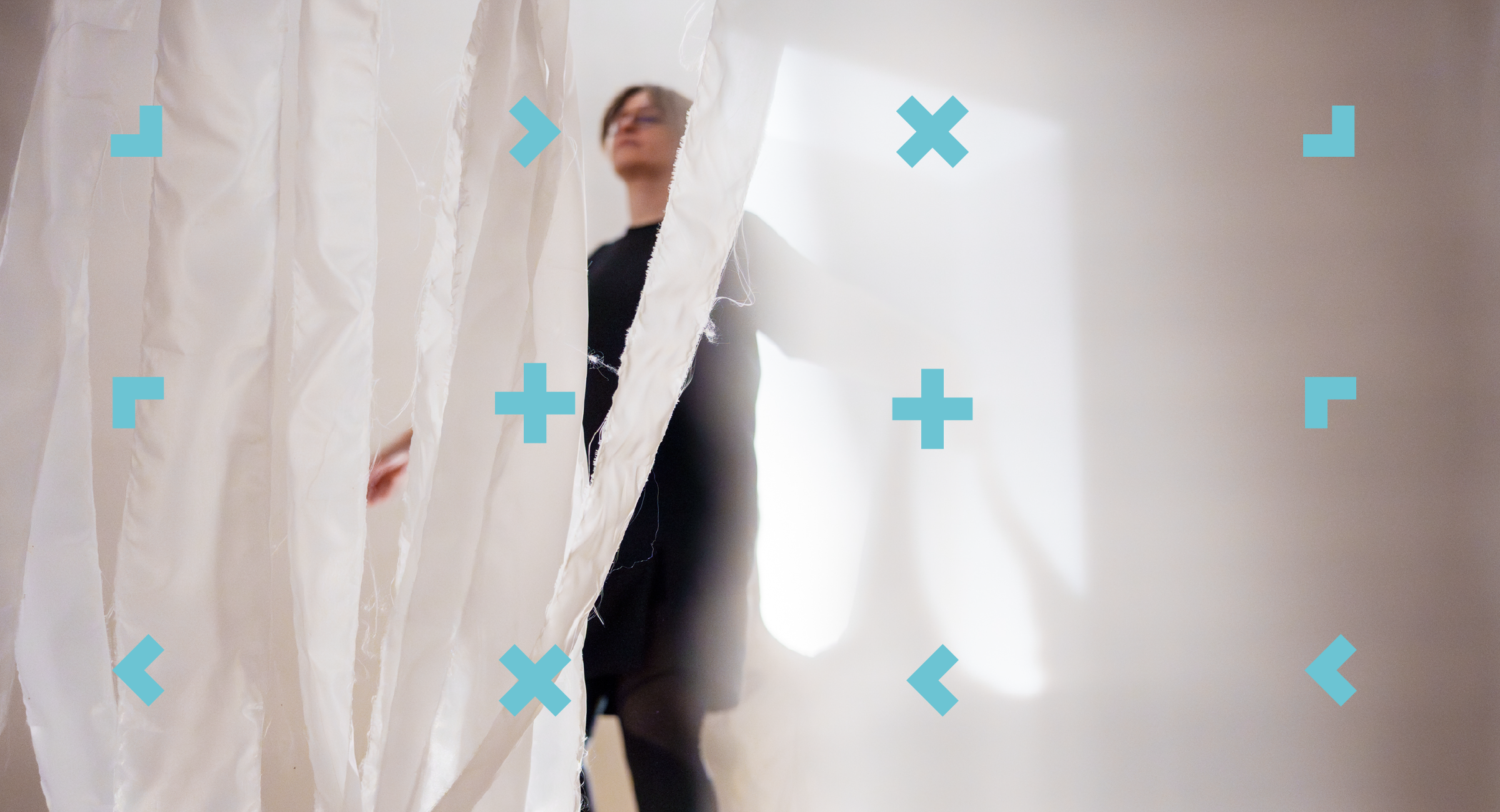
Neurodiversity embodiment laboratory | workshop for adults | The Art of Sensitivity
About the event
Do you sometimes fidget with your leg, play with something in your hands, or repeat a movement when you are concentrating or trying to calm down? Or maybe you have your own ways of taking a break from excessive noise, light or other stimuli? Every body has its own needs, but we don’t always give ourselves the space to notice and understand them.
During the workshop for adults entitled ‘Neurodiversity embodiment laboratory’, we will look at how movement, sound and touch affect our well-being and the way we perceive the world. Together with Monika Popiel and Paweł Świerczek, we will experiment with movement and the senses, discover unconventional ways of communicating and see what happens when we stop conforming to established patterns for a moment. You don’t need to have any dance experience or special skills – all you need is curiosity and a willingness to explore different ways of experiencing the world. This is an opportunity to take a closer look at ourselves and others, and to realise that there is no single right way to feel, to move or to be together.
Why should you come?
- You will notice how you react to stimuli and what you need to feel comfortable.
- You will experience something new – you will experiment with movement and your senses in a safe space, without the need for any prior experience.
- You will give yourself time for mindfulness – you will take a break from your daily responsibilities and focus on your own feelings.
About neurodiversity
Neurodiversity starts with a simple fact: no two nervous systems are identical. We differ in the way we perceive and process stimuli, move, learn, communicate, rest and relate to the world. Although this diversity is part of social and biological reality, our culture often leaves little room for curiosity about it. Instead of asking how my body and senses actually work, we primarily learn to conform to a specific model of functioning. Anything that deviates from it is often perceived as a problem, a deficiency, a disorder or simply a quirk.
And what if we flip this perspective? Instead of asking how to conform to the norm, start looking at how we can function differently – in our own way, in accordance with our own resources and cognitive abilities.
Neuroqueering is the practice of questioning the neuronorm and seeking alternative ways of feeling, knowing and being together. It is an attempt to imagine a world in which different ways of functioning do not have to be hierarchised, and difference can become a source of knowledge and creativity. During the workshop, we will neuroqueer through the body and the senses. Going beyond established motor and cognitive norms, we will look for gaps in the neuro-norm and ways to embody neurodiversity in everyday life.
We will begin our adventure by exploring stimming (self-stimulatory behaviours), i.e., repetitive movements and sounds that neurodivergent individuals perform to regulate emotions and sensory processes. However, stimulation is much more than that. It has the potential to become a sensory language – we just need to learn to listen to it, not through passive reception, but through the mutual choreography of bodies and affects. Together, we will explore these potential stims, which will open the way for broader reflections on autistic perception, neurodivergent corporeality, and movement as a matrix for perceiving the world.
The workshops are open to all adults interested in the topic of neurodiversity, regardless of their movement experience, identity, age or level of fitness. With great attention to needs and boundaries, we will work with movement, sound and touch. As we will be working in groups, it is advisable to be prepared for physical interactions with other people.
About the instructors
Monika Popiel (pronouns: any) works at the intersection of various disciplines, blending artistic, technological, and research practices. She graduated in directing from the Theatre Academy in Warsaw and in applied mathematics from the Gdańsk University of Technology. At the core of her work is the body as the primary site of experience, relationships, and knowledge. In her explorations, she combines performative, relational, sensory and somatic arts with embodied practices of textile making, electronics design and interface programming. She creates interactive meeting spaces in which the body and the senses not only become the material and tool for action but also actively co-create them. Her works explore the dynamic relationships between bodies, memory, imagination, technology and the multisensory experience of the world. By working intensively with the sense of touch, interoception and movement, she poses questions about empathy, co-existence in uncertainty and dissonance, and the possibilities of joint action.
Website: monikapopiel.com
Paweł Świerczek – graduated in Cultural Studies from the University of Silesia in Katowice and from the Laboratory of New Theatrical Practices at SWPS University in Warsaw. He works at the intersection of performative and relational practices, artistic research, and (neuro)queer activism. At the centre of his interests are the tensions between identity politics and embodied experience, particularly queer and neurodivergent experience. In recent years, he has primarily explored the queer heritage of Upper Silesia (‘Of Coal and Rainbow / Wungiel i donga’, Sophienasele, Berlin 2018; ‘From Ahead Our Time’, Favoriten Festival, Dortmund 2022; Śląsk Przegiety collective, 2018–) and the bodily experience of neurodivergence (‘Stimpathy’, Fresh AIR, Berlin 2026). Since 2023, he has been practising and teaching the embodied communication method known as Authentic Relating.
Website: pawelswierczek.com
Details
When: 24 October 2026 (Saturday), 10:00-18:30 (a one-and-a-half-hour break is scheduled during the workshop)
Where: Workshops of Culture in Lublin, Grodzka 7, exhibition hall, 2nd floor
For: adults
Registration: via the online form
Free of charge, places are limited and allocated on a first-come, first-served basis
Accessibility
- A sensory-friendly workshop.
- Noise-cancelling headphones are available on site.
- The event takes place on the second floor. There is no lift.
- Let us know about your individual accessibility needs using the online form when registering.
- Read the basic accessibility information about the Workshops of Culture.
- Find out how to get there – watch the video.
We also recommend
26 October – 13 November 2026 | Monika Popiel and Paweł Świerczek – Stimpathy | exhibition
The ‘Art of Sensitivity’ project was co-financed by the Minister of Culture and National Heritage from the Culture Promotion Fund.